

AI in Managed File Transfer

Learn how AI is being applied to Secure File Transfer, including what's possible, the benefits, guardrail considerations, associated costs, and what the future holds for AI in Managed File Transfer.

Book an AI Consultancy Call Explore AI in MFT
Isometric AI illustration with blue and gold outlined 3D “AI” letters at the center, surrounded by connected icons for analytics, coding, data, and cloud computing.


Section 1

What is AI in Managed File Transfer?


Like many enterprise technologies, MFT software vendors are introducing AI capabilities into their product roadmaps as organisations look for new ways to improve efficiency, strengthen security, reduce manual effort, and gain greater visibility into their file transfer operations. 

From failure analysis and anomaly detection to automated reporting and using natural language to interact with your MFT system, AI is transforming how organisations manage, monitor, and maintain critical file transfer processes. While AI won't replace the core functionality of MFT, it can enhance how you use it.

With so much happening in this space, it can be difficult to separate the hype from what’s genuinely possible. Pro2col helps organisations cut through the noise and understand how to leverage AI within their existing technology stack. This page brings everything together in one place, exploring current applications, deployment approaches, future capabilities, costs and the guardrails needed to adopt AI responsibly within your MFT environment. Once you've explored the possibilities, book a call with one of our AI Integration Specialists to discuss your own requirements and discover how AI could deliver value within your MFT environment.


Section 2

Why Organisations Are Adopting AI in MFT


Much of the demand for AI in Enterprise File Transfer is being driven by two key goals:


Section 3

How AI is being Deployed in MFT Systems


There are several ways organisations can integrate AI with their MFT environment. We’re seeing a few common approaches emerging, depending on how your organisation already uses AI, how much control you want over it, and where you want AI to sit within your existing tech stack.

Below are three examples of ways AI can be deployed with MFT including through an MCP gateway, directly within the MFT application, or as a separate AI agent working alongside it.

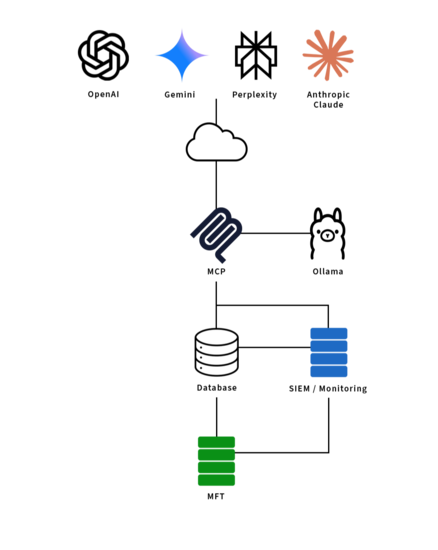
AI Deployment Method 1: Using an MCP Before the AI Engine

Using an MCP Before the AI Engine-1-1

This deployment method is suitable for organisations that already have an established AI strategy, or want to build one to a standard that supports compliance, and centralises AI functionality across all applications. It uses a Model Context Protocol (MCP) server that acts as a controlled gateway between your internal applications and your AI platform of choice.

In this example, the MCP server connects the MFT platform, SIEM and supporting databases to the AI engine. Rather than connecting AI directly to individual systems, the MCP provides a centralised layer through which information and functionality can be securely exposed to the AI platform.

Pro2col is already working with a number of clients to build out this type of framework. We see significant value in this approach for organisations looking to integrate AI across their wider technology environment, providing a more centralised and controlled way to connect MFT with other systems and applications.

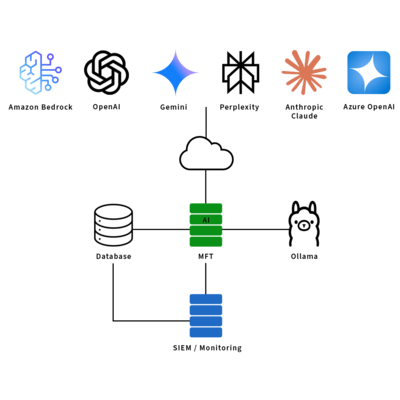
AI Deployment Method 2: AI built directly into the MFT application

AI built directly into the MFT application

Another approach to deploying AI into MFT, and one we’re seeing software vendors working with, is to build the AI interface directly into the MFT application itself. In this model, the MFT platform provides administrators with an AI interface within the existing administration console, allowing them to interact with AI without leaving the MFT environment.

Some MFT applications use an AI platform of their choosing, such as Amazon Bedrock, to power this functionality and support the AI workloads and accuracy of the responses generated. Others provide the option to connect to your own AI platform through an API, giving organisations greater choice over the AI technology they use.

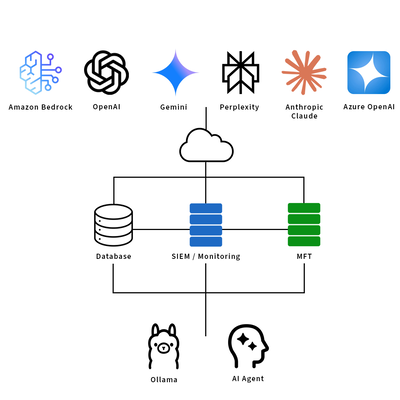
AI Deployment Method 3: A separate AI agent accompanies the MFT system

A separate AI agent accompanies the MFT system

A third approach that we’ve seen being used with MFT software vendors is to deploy a separate AI agent alongside the MFT environment. In this deployment model, the AI interface sits outside the MFT application and is configured to work with the specific applications data sources.

Depending on the application, organisations have the option to connect to their own AI platform or use an AI service provided by the vendor. Alternatively, organisations can build their own AI agents and interfaces that are native to their chosen AI platform, combined with API calls and connections to MFT data sources, to in effect build your own tailored AI interface.

Which AI Deployment Approach Is Right for You?

Each of these deployment methods has its place, and the right approach depends on your requirements. While AI capabilities built into MFT software offer convenience, you're relying on your software vendor to develop and deliver the functionality you need. So, should you have specific requirements, these  may not be a priority on your vendor's roadmap. 

In that case, it’s worth considering what you want to achieve today. Pro2col can help you explore the options available and identify the right deployment approach to meet your specific requirements.


Section 4

Common Applications of AI in File Transfer


Organisations are under increasing pressure to understand how AI can deliver real value within the systems and processes that are already being used within their environment.
 
Many Managed File Transfer software vendors have either already released AI capabilities or announced plans to incorporate AI into their product roadmaps. While the maturity of these features varies between solutions and adoption is still evolving, common use cases are beginning to emerge across the market.
 

Workflow Design & Optimisation

One of the most common applications of AI within MFT is workflow creation and management. Natural language processing allows administrators to describe what they want a workflow to achieve in plain English, making it easier to build and configure workflows without needing extensive technical knowledge. AI can also review existing workflows and suggest improvements, whether that's enhancing performance, strengthening security controls, or improving compliance.

Anomaly Detection

AI is effective at recognising patterns with file transfer activity and behaviour that deviates from what is normal. This includes unusually large uploads, unexpected download volumes, missing file transfers, or sudden changes in workflow activity. Where anomalies are detected, AI automatically triggers alerts, approval workflows, or further security investigations.

Strengthening Security & Threat Management

At its core, this is about identifying and responding to malicious activity before it becomes a security incident. Many security controls already rely on predefined rules, such as blocking known malicious IP addresses or locking accounts after a certain number of failed login attempts. AI analyses patterns of behaviour over time and identifies threats that are difficult to detect using traditional rule-based approaches.

In environments where IP whitelisting is not possible, AI detects changes in source locations, connection habits, or transfer behaviour from otherwise legitimate users, helping IT teams spot risks earlier and respond more effectively.

Compliance Monitoring

Many MFT platforms already include built-in controls to help organisations meet regulatory requirements such as GDPR, PCI DSS, and other industry standards. However, AI provides an additional layer of validation by reviewing configurations, policies, and activities against compliance requirements. AI also identifies deviations from compliance policies and alert administrators when changes, behaviours, or workflows fall outside of expected regulatory requirements, allowing organisations to take corrective action before they become a concern.

From a data protection perspective, AI supports Data Loss Prevention (DLP) initiatives by helping identify personally identifiable information (PII) and other sensitive data moving through file transfer workflows. While dedicated DLP solutions remain the preferred approach today, AI-driven analysis is rapidly evolving and is set to become an increasingly effective tool for detecting and protecting sensitive information in the future.

Natural Language Processing

Large Language Models (LLMs), the technology behind tools such as ChatGPT and Microsoft Copilot, enable new ways for administrators to interact with MFT platforms. Rather than navigating multiple dashboards, searching through documentation, or manually reviewing logs, administrators simply ask questions in natural language and receive relevant answers from the system. 

Beyond retrieving information, natural language interfaces can also assist with administrative tasks and workflow creation, reducing the manual effort required to build and deploy new processes.


Section 5

Key Benefits of AI in MFT


The specific applications of AI varies between different MFT software solutions, however the benefits are largely consistent. Integrating AI with MFT helps teams work more efficiently, reduce operational burden, and maximise the value of their Managed File Transfer investment.


Section 6

Integrating your MFT into your Existing AI Tech Stack 


Integrating AI with your MFT tool starts with establishing a trusted connection between the two technologies. Whether you're using OpenAI, Ollama, or another AI application, authentication is a key requirement.

Your AI platform will provide an authentication key. Your MFT solution must be configured to recognise and securely accept it. Once established, this connection can be reused across different workflows and automated processes, much like a host connection within your MFT platform.

Next, you need to establish how the two technologies will communicate. This could involve APIs, web services or emerging standards such as the Model Context Protocol (MCP), depending on the capabilities of your MFT platform and AI application.

Connecting AI to your MFT environment isn't something to approach blindly, particularly given the sensitive nature of the data your file transfer systems handle every day. Pro2col’s expert team can help you navigate these complexities, assess your requirements and identify the right integration approach for your environment.


Section 7

The Future of AI in MFT


While many of today's capabilities focus on assisting administrators with monitoring, troubleshooting, reporting, and workflow management, the future of AI in MFT is going to be far more advanced. 

We’re seeing growing discussion across the industry about how these capabilities could develop and be applied to file transfer. Through our work with clients and technology partners, Pro2col is closely involved in these conversations, bringing our practical MFT expertise and real-world experience into the product development cycles. The following capabilities highlight some of the possible applications emerging from these conversations.

Adaptive Key Management

AI could play a role in dynamically monitoring the strength and suitability of encryption methods being used within active workflows. For example, if a cipher or encryption standard is identified as weak or compromised, AI would automatically alert administrators, disable affected workflows, or a particular execution. 

Predictive Preventative Maintenance

AI could analyse trends and performance to identify issues before they impact services. Rather than waiting for systems to fail, AI can recognise signs of resource constraints, performance degradation, or unusual behaviour and force automated maintenance activities such as restarting services or recommending upgrades. In more advanced cases, it could action hotfixes and update your software. 

Transfer Optimisation & Adaptive Workloads

AI has the potential to continuously analyse transfer activity and identify the most efficient times to execute workflows. While experienced consultants, like Pro2col already perform this type of analysis during software health checks, AI could carry out these reviews much quicker, automatically and on an ongoing basis.

Issue Resolution

AI is already helping administrators identify the causes of failures and operational issues. However, it's important to consider repeat failures will result in unnecessary AI token costs. Future developments are likely to focus on improving how this knowledge is captured and applied. AI could build and maintain knowledge bases based on previous issues, resolutions, and operational experiences, reducing unnecessary processing costs. 

Access Reviews

Access reviews are a fundamental part of security and governance, with most organisations periodically reviewing the system permissions granted to administrators and end users. However, these reviews are time-consuming and only performed periodically. In future, AI could continuously monitor user access, identifying dormant accounts, excessive permissions, policy violations, and unusual changes in privileges on a daily basis, alerting those managing the system whenever access rights no longer align with company policies.

These are just a handful of the possibilities that we as experts, foresee are on the horizon. The reality though, is AI is evolving rapidly, and what seems innovative today will be standard functionality within the next 6 to 12 months.

For Managed File Transfer teams, AI presents an opportunity to reduce operational effort, improve resilience, strengthen security, and gain even greater value from their file transfer environment. Organisations seeing success are taking a strategic approach to adoption, integration and governance.


Section 8

AI Guardrails & Governance


Guardrails are the controls that determine what an AI system can do, what information it can access, how it responds, and the actions it's allowed to take. Whether an organisation is using generative AI to answer questions or agentic AI to take actions on its behalf, guardrails help ensure AI operates safely, securely, and in line with business requirements.

Controlling Response Tones: Guardrails can be used to influence the tone, style, and nature of responses. 

Regulatory Compliance Restrictions: A guardrail can be used to restrict AI activity in line with regulatory and compliance obligations. 

Governing Information Sources: Guardrails can determine where the information comes from. You may want to restrict queries to approved internal documents and knowledge bases, rather than the open internet. However, internal content can also be outdated, so it’s important to ensure information is accurate, relevant and regularly reviewed.

Activity Limitations: Guardrails can also be used to control actions rather than just responses, in terms of agents and the decision of how much autonomy they are willing to provide. 

Importantly, guardrails apply equally to both generative AI and agentic AI. Whether AI is responding to a user query, analysing data, generating content, or actively carrying out tasks on behalf of an administrator, the same principles of governance, security, control, and oversight remain essential.


Section 9

Cost of AI in MFT


The cost of introducing AI into your MFT environment depends on your specific requirements including how it's deployed, how frequently it's used, and how your chosen software vendor prices its capabilities. As these features are still developing, pricing models vary across the market.

Currently, we're seeing two common approaches: usage-based pricing and tier-based pricing. Usage-based models typically charge according to consumption, such as the number of tokens processed through an AI model. Tier-based models offer access to defined features within a particular licence or subscription. Some platforms, including Files.com, don't charge separately per token for their AI capabilities. You can also run models such as Ollama on your own infrastructure, avoiding per-token API charges. However, you'll still need to account for the computing power. The right approach depends on your use case, existing technology stack and the value you're looking to achieve.


Section 10

Next Steps


Not every AI feature will be right for every organisation. Whether you're looking to integrate AI with your existing solution, evaluating new platforms, or simply looking to understand what's possible right now, taking a strategic approach to adoption is essential. 

Based on our experience as leading file transfer experts, organisations achieving the greatest success typically start by assessing their AI readiness, and the specific business challenges they are trying to solve. This is followed by understanding the capabilities and roadmap of their existing MFT platform, understanding what's achievable today and what's coming in the future aligns with long-term objectives.

Our AI Integration Specialists can help you identify pain points, understand your existing technology stack and explore where AI will deliver real value within your MFT environment. Get in touch with Pro2col to discuss your requirements and find the right approach for your organisation.

Maturity Model Banner

label-guide


Assess Your MFT Maturity

See how your MFT environment measures up. Use our Maturity Model to assess your current capabilities, identify areas for improvement and understand where to focus your next steps.

Read The Guide
MFT Shield Security Icon-1-1

label-guide


Add an Extra Layer of MFT Security

Explore how MFT Shield helps protect your Managed File Transfer environment by creating an additional security layer between external sources and your core MFT system.

View The Latest List
Untitled (35)-2

software copy


Rethinking Security with Zero Trust

Discover how a Zero Trust approach to data transfer can strengthen your organisations security posture, reduce unnecessary access and help protect sensitive data across your organisation.

Download The Whitepaper


Frequently Asked Questions


What is AI in Managed File Transfer (MFT)?

AI in Managed File Transfer (MFT) refers to the use of Artificial Intelligence to improve how file transfer environments are managed, monitored, secured, and optimised. AI can assist with tasks such as workflow design, troubleshooting, anomaly detection, security monitoring, reporting, and compliance.

Rather than replacing traditional MFT capabilities, AI enhances them by helping organisations analyse large volumes of operational data, automate repetitive activities, and identify issues more quickly. As AI technology continues to mature, it is expected to play an increasingly important role in supporting file transfer teams and improving operational efficiency.

Can AI improve file transfer security?

Yes, AI can help improve file transfer security by identifying unusual behaviour, monitoring user activity, detecting potential threats, and highlighting security risks that may not be obvious through traditional monitoring methods.

AI capabilities today can analyse transfer patterns, login activity, connection behaviour, and file movement trends to identify anomalies or suspicious actions. While AI should not replace existing security controls, it can provide an additional layer of intelligence that helps organisations strengthen their security posture and respond to threats more effectively.

What are the risks of using AI in Managed File Transfer?

MFT systems handle sensitive business data, from financial information and patient records to confidential documents and intellectual property. Organisations invest heavily in protecting their data, so introducing AI creates additional considerations around how that data is accessed, processed, and stored to prevent it from falling into the wrong hands.

One of the key considerations is where your data goes when an AI tool processes it. If you're using a platform connected to the internet, what information is being shared, where is it processed, and how is it stored? Could sensitive files or transfer logs be exposed outside your organisation? These are important questions to answer before connecting an AI application to your environment.

You also need to consider what information the AI can access and how reliable that information is. If it draws on internal knowledge bases, outdated information could lead to incorrect recommendations. If that information is accidentally deleted, the quality of its responses could be affected. Equally, granting an AI application too much access or allowing it to take actions without appropriate oversight could introduce further risks.

Integrating AI safely in MFT requires a clear understanding of how the technology operates, what data it can access and what it is permitted to do. Pro2col can help organisations assess these risks before implementation and ensure appropriate controls are in place to protect their data, maintain oversight and prevent unintended consequences. Book a call with one of our AI Integration Specialists.

How are Managed File Transfer software vendors incorporating AI?

Many Managed File Transfer software vendors have already released AI capabilities or announced plans to integrate AI into their platforms. Areas receiving the most attention include workflow optimisation, troubleshooting, reporting, security monitoring, anomaly detection, compliance support, and natural language administration. While the maturity of these capabilities varies between vendors, AI is becoming an increasingly important part of MFT product roadmaps.

As a vendor-neutral consultancy that specialises in secure file transfer, Pro2col works with one of the largest portfolios of Managed File Transfer solutions in the market. This breadth of expertise gives our consultants first-hand experience across a wide range of vendors, including GoAnywhere MFT, MOVEit, Globalscape EFT, Diplomat, and Files.com.

Whether you're looking to understand the AI capabilities within your existing MFT platform, evaluate new solutions, or gain insight into vendor roadmaps, our team can help. With over two decades of file transfer expertise, we work closely with organisations to understand where AI can support operational efficiency, security, compliance, and long-term strategy.

How is Pro2col helping businesses integrate and implement AI in MFT today?

Pro2col is already working hands-on with AI in Managed File Transfer, exploring existing AI capabilities within MFT platforms. We been working directly with software vendors, including Fortra and Progress, sharing feedback on our clients’ needs and helping shape the development of AI capabilities across their technologies.

Our experts have also extensively tested what can be achieved beyond built-in platform features. In a recent episode of The Transfer Files, our Principal Technical Consultant, Richard Auger, explores practical examples of how AI can be integrated with MFT today, without having to wait for new vendor releases.

If you're interested in understanding how AI can work with your existing MFT systems and wider technology stack,  Pro2col offer a free AI consultancy session to help you explore the possibilities, understand the capabilities available and identify how AI could deliver value within your organisation. Get in touch with one of our Integration Specialists today. 

Back to top